



Varicella Zoster Virus Encephalitis – Jeanne’s Story
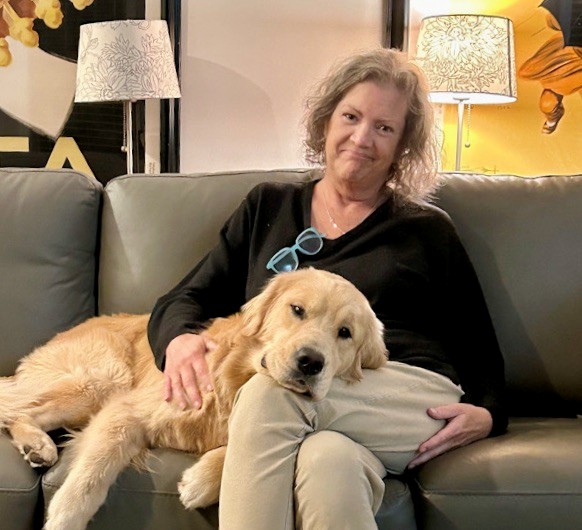
Jeanne’s husband, Paul, shares her struggle following a VZV encephalitis diagnosis which tragically led to her passing away.
Jeanne as a writer
My wife, Jeanne, was a professional communicator and writer. She had just finished her first novel, Descended from Kings, a fictional account about warring cities in a distant world that she described as foreshadowing the Viking invasion of the British Isles. Its main character was a strong, independent woman surviving in a male-dominated world. The book was published online and, to our surprise, sold well in Japan. We had been discussing her follow-up book, and she had just begun drafting an outline, when she fell ill.
The first signs
Her symptoms began appearing in April 2023. She struggled to hold a fork or spoon. She seemed distracted and confused. One morning, she reminded me to take the Thanksgiving turkey out of the oven – it was June. She also began having brief fainting-like spells, and her decline quickly became frightening.
Searching for answers
Our initial experience with healthcare was frustratingly vague. Her first of many trips to hospital failed to produce a diagnosis. We were sent to numerous doctors, none of whom could explain her symptoms. Several suggested tick fever, and doctors admitted her symptoms could be almost anything. No one mentioned encephalitis until September 2023, when a lumbar puncture revealed the varicella zoster virus (VZV) in her spinal fluid. It was five months after her symptoms first appeared. By then, her condition was too advanced, although we did not realise at the time that her fate had effectively been sealed.
A rapid decline
Her symptoms became increasingly catastrophic. She lost control of her bodily functions, which prompted several emergency room visits. Several times, she lapsed into unconsciousness. Her mind diminished into chaos and confusion. I had to call for emergency rescue at least a dozen times when she collapsed and I could not lift her. More doctors became involved and, for a time, they prescribed a regime of physical therapy. It was useless. After two MRIs, another doctor told us to get her hospitalised immediately because the scan revealed substantial brain damage. She was put on the anti-viral acyclovir, and for a few days she seemed to be recovering. Instead, her symptoms worsened.
Care, hospice and loss
By early 2025, Jeanne could no longer stand or walk, and her hands became useless. A succession of home care aides came to bathe her and comb her hair. She faded in and out, and worried incessantly about her book writing and our dog, who guarded her and fought with other dogs on walks. Eventually, I had to give our dog up for adoption. As I entered bankruptcy because of the high costs of her care, I was finally able to arrange hospice care for her. They were very professional and caring, but made it clear that there would be no recovery. Nurses were always on call and visited often. A counsellor helped me confront the reality of her deterioration and begin planning for what would happen. In late October 2025, my children had come for a visit. We were watching a movie on the TV when my daughter went to check on her. Jeanne was gone. Death came on 25 October 2025.
What I want others to know
I remain angry and filled with regret that no one in healthcare was able to correctly diagnose her condition quickly enough. I believe the lack of an immediate diagnosis doomed her. I had discussed a brain autopsy with one of her doctors, but she passed before arrangements could be made. I have read enough to know that encephalitis outcomes are better if diagnosed quickly. In Jeanne’s case, it took months from the onset of symptoms until a cause was found. If I had anything to offer, it would be that physicians, neurologists and others come to understand that encephalitis symptoms may resemble other causes, but it must be considered urgently when those symptoms take over the brain with cruel speed. One day, Jeanne was working on her next book. The next day, she collapsed on the floor, her body and mind out of control. I wish my experience were happy and uplifting, but if people can understand that a quick diagnosis is essential, Jeanne’s death will not have been in vain.
If you would like to speak to our support team about encephalitis, please contact our helpline.
Story published September 2026
Get help
Our support team are available from 9am to 5pm (GMT), Monday to Thursday, and 9am to 4.30pm (GMT) on Fridays.
To get in touch, simply call +44(0)1653 699599.
Contact our helpline