

If We Didn’t Lead on Encephalitis, Who Would?
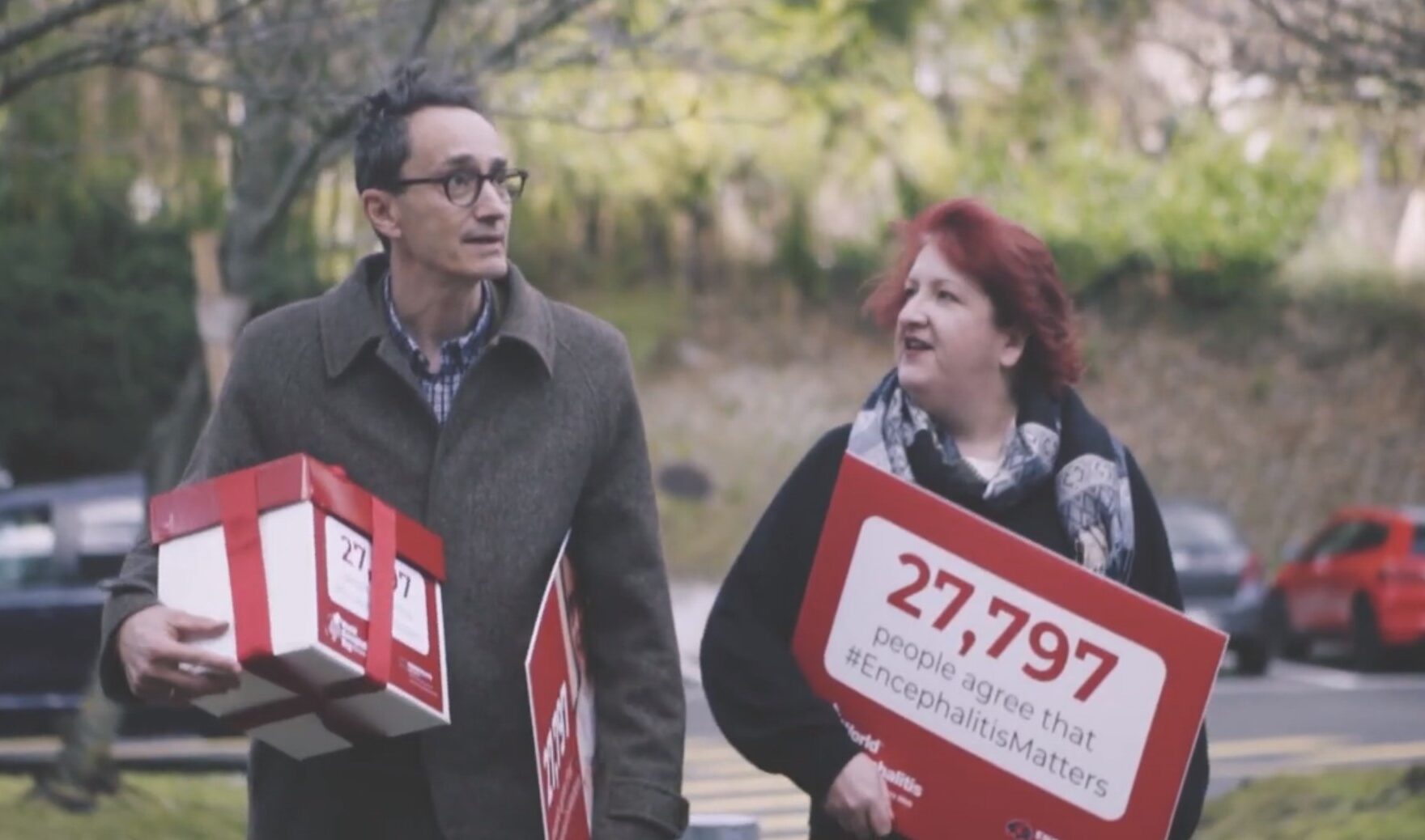
There was a moment—quiet, uncelebrated, but pivotal—when our community collectively realised something profound: if we did not lead on the encephalitis agenda, no one else would.
There would be no trusted information for families suddenly thrown into crisis.
There would be no coordinated awareness raising.
There would be no patient voice shaping policy or research priorities.
There would be no global champion calling out the lack of diagnostics and treatment.
And, perhaps most starkly, most people would still not know what encephalitis is.
That is not hyperbole. It is history. It is reality. Our reality.
We hear it time and again from survivors and families: “I had never heard of encephalitis until it happened to me/my family.” A parent describing how their child deteriorated in front of them while clinicians searched for answers, or how the child that came out of hospital was not the child they gave birth to. A caregiver who later tells us “ If I’d known what encephalitis was, I would have pushed harder, sooner.” A young adult sent to a side ward to ‘sober up’. Their crime? To have been out partying with friends so obviously their behavioural change must be related to alcohol or drugs. But it wasn’t and they never came home.
Encephalitis has never been an “easy” cause. It sits at the intersection of autoimmune and infectious disease, neurology, immunology, neuropsychiatry, disability, and global health inequity. It is complex, frightening, mis- and under-diagnosed, and too often misunderstood. And for decades, it fell through the cracks.
So Encephalitis International stepped in.
Not because it was simple.
Not because it was well funded or well researched.
But because the consequences of not stepping in were unthinkable.
So why haven’t we fixed it yet?
This is a question we ask ourselves constantly—and one we know our community sometimes wonders about too.
After all this time, why is encephalitis still under-recognised?
Why do people still struggle for diagnosis?
Why is treatment access still so unequal across the world?
Why have so few people still not heard of it?
The honest answer is this: we are trying to change an entire system without sufficient funding and with limited resources that were never designed to support systemic change.
Raising awareness of encephalitis means changing clinical behaviour, public understanding, government priorities, research pipelines, and global health infrastructure. It means influencing education curricula, emergency pathways, surveillance systems, data capture and analyses, and funding models. This is not a singular crusade. It is a long, grinding, uphill effort—made harder because so few people have heard of it or know what it is, and because it does not receive the same research and funding investment as other comparable neurological conditions.
One survivor told us recently: “I survived encephalitis, but I lost my job, my marriage, my confidence, and the person I used to be. People see that I’m alive and assume I’m fine.” That gap—between survival and recovery, between being alive, being supported, and leading a fulfilling life – is precisely the gap we are trying to close.
Progress has been made—often quietly, often invisibly—but it has never been linear, and it has never been easy.
The paradox of charity: expected to change the world, yet forbidden to build the machinery
Here is a paradox we need to talk about more openly.
If you were an investor funding a biotech company, you would not expect your money to be spent only on a test tube or a production line. You would expect it to fund the scientists, the infrastructure, the regulatory expertise, the quality control, the manufacturing systems, the leadership, and the long-term strategy. Without those “overheads,” nothing would ever reach patients.
Yet when a non-profit seeks the resources it needs to innovate, scale, and lead, it is often criticised for doing exactly what success requires.
Social change expert Dan Pallotta has argued powerfully that we have created a double standard: we allow the private sector to use money aggressively to solve problems, but we expect charities to do so quietly, cheaply, and without building capacity. We reward frugality over effectiveness. We confuse low overheads with high impact.
But you cannot solve complex global health challenges on goodwill alone.
To do the best work, you need the best people, and you need to invest in them.
To lead globally, you need a global infrastructure.
To influence research, policy, and practice, you need credibility, data, and sustained presence.
None of that is free!
Why Encephalitis International matters now more than ever
Encephalitis does not have the luxury of waiting.
Without Encephalitis International, research slows and may even stall.
Without advocacy, inequities persist, people die and people are left with life-changing disabilities.
Without awareness, people continue to be misdiagnosed or diagnosed too late.
In many countries, families still face encephalitis with no diagnosis, no treatment pathway, and no explanation. Parents describe children who never return to school. Adults who survive but are unable to work again. Families are torn apart with relationship breakdown and mental health problems. Lives permanently altered—often without anyone ever naming the condition that caused it.
Without an organisation willing to hold the long view—to keep pushing when progress feels painfully slow—encephalitis risks slipping back into obscurity.
We don’t say this to centre ourselves. We say it because leadership in this space is fluctuating and fragile, and it exists only because people choose to invest in it.
A shared responsibility
This is a conversation we want to have honestly and respectfully—with our beneficiaries, our supporters, our corporate partners, and our funders and major donors.
If you believe that people affected by encephalitis deserve better futures, then investing in Encephalitis International and our capacity to deliver that change is not optional. It is essential.
Awareness does not raise itself.
Research does not organise itself.
Equity does not champion itself.
And encephalitis will not fix itself.
We are proud of what has been built so far—but we are equally clear-eyed about what it will take to go further. Changing the dial on encephalitis requires not just passion, but permission: permission to build, to lead, to invest, and to think at scale.
As someone once said to me if you keep doing the same you will keep getting the same. If we don’t lead on encephalitis, history has already shown us what happens next.
Nothing.
I once asked someone who had made a donation why they had not supported us before. Their answer shook me to my core: “Because you never asked me”. So here I am, asking YOU now. We need your support now please.
By Dr Ava Easton, MBE, Chief Executive, Encephalitis International