
Tick-borne encephalitis – Bill’s story
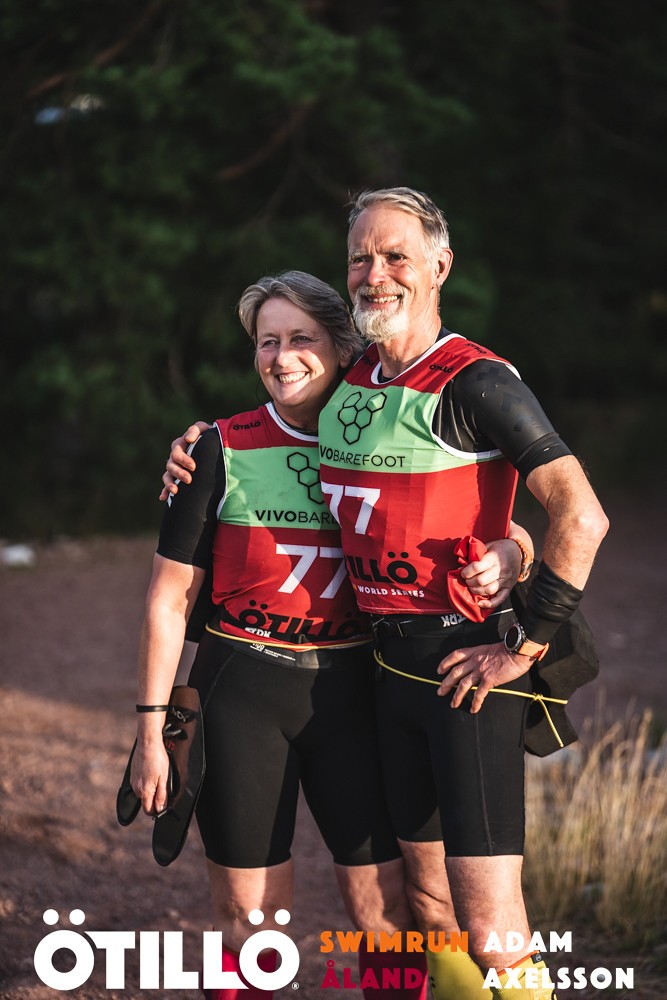
My name is Bill and I went from stopping my Garmin watch after a swimrun race of over 50km (including 10 km of swimming in the Baltic sea) to seriously ill in hospital and facing some unwelcome sequelae in less than a month.
Tick-borne encephalitis (TBE) is virtually unknown in the UK and most likely I was infected while swimrunning on holiday in Sweden and Finland. There is no characteristic skin response and I never saw a tick or indeed any skin symptom that looked different to the midge and mosquito bites one inevitably picks up in Nordic countries. Initially I assumed my illness symptoms were a cold picked up on the flight back. After two weeks of increasing fatigue, muscle aches and fever I rationalised it must be flu and waited for the morning I’d feel normal again.
Diagnosis
Alarming symptoms hit me over a couple of days, a horror show of unbearable headache, fatigue, vision difficulties and loss of balance that put me in hospital where I had multiple intravenous drug infusions, blood tests, scans and a cerebro spinal fluid (CSF) sampling. I somehow failed to absorb the messages about potential outcomes and relaxed in the feeling the hospital staff were doing everything possible to sort me out. I credit this ignorance and confidence with why I didn’t express the post-traumatic stress disorder (PTSD) that is not unusual after TBE hospitalisation. That’s not to deny this is an emotional journey and I went to some dark places under my own steam. I cried a lot in hospital, sometimes in fear, sometimes in pain and also in gratitude for the efforts of staff and messages from family and friends. Fortunately, the alarming nightmares of being stalked by a giant melanistic boa constrictor in a variety of scenarios have faded. Nevertheless, with a lot of my time spent at home alone, it still gets a bit dusty particularly reading other experiences of TBE or thinking about friends facing difficult health challenges.
As sorry as I feel for myself, I am also aware there are impacts of this disease on others. For about 10 days after discharge I would have struggled to look after myself alone and I was heavily dependent on my wife for assistance. Family and friends closest to me were not only coping with the acute illness and the fear about extreme outcomes during the hospital stay, but also longer term impacts. They also dealt with the slow pace of improvement, then ultimately the “new” version of me that emerged from the potentially incomplete recovery and maybe they hold a perception of altered personality that challenges one’s own view.
Recovery
During that first month of recovery, some symptoms improved or disappeared, thankfully my balance improved dramatically and almost returned to normal. Less welcome were the symptoms such as memory loss. I experienced short term memory and found learning, manageable but frustrating. Three months on, my spatial perception has improved. I pick up the odd bruise and cut from impacts on inanimate objects, more than I’d like, but I can ride a bike safely. Coordination issues such as dropping of items for example when cooking, are also improving and that’s accompanied by a reduction in the use of expletives in the kitchen. Tinnitus and hearing impacts are notable but controllable.
Three months later, my physical recovery is going well and I hope it is a positive aspect other TBE patients might benefit from. In six weeks I went from being only capable of walking 500m once in a day to around 90 minutes across three daily walks with our dogs, cycling up to 20 minutes there and back from town to meet friends and swimming twice a week. It was a beautiful experience going swimming again with triathlon club friends. Yes this is tiring in its own right, nonetheless, random leg tremors that struck me in the first six weeks seem to have gone, so unsurprisingly, I am delighted and feel motivated to carry on working on this. Starting running again is the next step although for the moment I fear failure with this. Muscle weakness is real, particularly in my legs. My realistic stretch target is to hit 50% of my exercise volume prior to TBE. That should see me able to finish shorter distance swimrun events from mid 2026 and beyond. At least for now, I can rationalise that never again will I be able to finish the long swimrun events we used to participate in, that’s not to say I’ve given up or that I don’t mourn the athletic ability of my former self, it’s a question of there are bigger challenges in the recovery.
Reflection
There is a bitter fight between me and the impact the virus had, over who is the most tenacious. My frustration with some of the symptoms has grown recently now that outwardly I appear fine and I sense the perception of others that all is good with me. Some of the neurological symptoms that so far seem resilient to obvious improvement and manifest themselves daily are: sleep disturbance, headaches, sudden onset of extreme fatigue, difficulty concentrating and fragile confidence. The irritation from this constellation of symptoms has a negative effect on my life. The impact on confidence may illustrate this. Whilst, it’s possible to engage fully for a reasonable period of time with friends, any new situation that is perhaps confrontational or more sensitive requires a massive mental effort that sees me exhausted within the hour or more likely folding early even if I’m 90% sure of my position. I may leave these encounters yearning for compromise and it always feels humiliating and at the same time invisible to others. Of course that’s all subjective, probably the best assessment of the real world impact is illustrated by the conclusion I will never be able to work full time again. That doesn’t stop my to-do list growing as each day passes, despite having all day, as I can only muster a limited effort of concentration to get tasks done. And I’m not letting time slip by watching TV, a lot of modern programming that takes my fancy is too fast moving and effect filled to be tolerable beyond a short time. Reading books that I thought could be the salvation for me with all this spare time is still not possible for more than a few pages and I’ve found podcasts and YouTube videos work best for me.
What’s next
I wanted to finish with “what’s next” . What are my goals? Apart from physical fitness my objectives remain undefined. The war is still on and while improvement since hospital discharge is a night and day difference, the day to day progress is variable and my horizon is shortened compared to earlier in the year. My medium term priority is to acquire the knowledge and tools to improve or manage the subjective neurological symptoms. Yes I can sympathise with family and friends looking to plan for the long term, but my heart says; how about making next week the best ever?
Fortunately, my outlook should continue to improve over the next 18 months. Equally, the odds are against a perfect recovery and being in my 60s it’s not clear where the new normal will be. So in the search for a more defined finish to this story I’ve opted to give advice for anyone who is active in nature, there is a vaccine for TBE and although the virus is very rare in UK tick populations and you will have to find a private travel clinic that will immunise you , the few hundred £ GBP spent is nothing compared to what’s at stake should you contract it. Swimrun athletes heading for races in the Nordic countries in 2026, you know what to do.
If you wish to speak to anyone following this story, please do get in touch: support@encephalitis.info or call +44(0)1653 699599
Story published March 2026
Get help
Our support team are available from 9am to 5pm (GMT), Monday to Thursday, and 9am to 4.30pm (GMT) on Fridays.
To get in touch, simply call +44(0)1653 699599.
Contact our helpline